
April 13, 2025: Palm Sunday
The Passion Narrative According to Luke
Trinity Episcopal Church, Brooklyn, CT
It is almost impossible to imagine how it must have felt. Riding into Jerusalem, the largest city of its day. At Passover. The largest religious event of its day. The city was most certainly packed to the gills. Wall to wall people. Standing room only. Exactly why Jesus was there.
And they knew who he was. A throng of humanity choked the streets as he arrived. I’m guessing there was a modicum of surprise though when he showed up not atop a stallion. Or ensconced in a chariot. But on the back of a donkey. A plain, ordinary ass. The most storied healer, teacher, prophet the world had ever known. Trundled into Jerusalem to star in a scene that would change the world forever, as though he were an average Joe. As though he were you. Or me. Can we imagine how it must have felt?
It was the dead of summer in 2018. We entered Jerusalem on a tour bus. Fifteen Christian clergy on a tour of the holy land sponsored by the Jewish Community Relations Council of Greater Boston.
We had come from Tabgha where Jesus is said to have turned two fish and five loaves of bread into a feast for five thousand. Hosanna! And from there we traveled to Capernaum to the house of Peter’s Mother-in-Law where Jesus healed the dying woman with nothing more than a loving word and a soft touch. Hosanna! And then to the synagogue where Jesus himself preached on the sabbath. Again, Hosanna! And from there to the place where Jesus offered his beatitudes, the eloquent assurance to all on the margins that they are at the center of God’s heart. Hosanna! And then on to Jerusalem. Ho…..oh no…..oh no…that’s right, its crucify him!
We got to the city late in the afternoon. It was packed with folks who had come from all over to march in the parade. And also some who had come to protest the parade. Emphatically. The road was lined with them. Protestors. Not an unruly crowd, but they were well chaperoned by a solid contingent of well-armed military might.
The protestors were shouting at the passing vehicles. Ours included. And thrusting their picket signs in the air. The message on the placards, mostly hand written in Hebrew was….loosely translated….Crucify them! They are an abomination! They violate God’s law! Crucify them!
It was surreal to say the least.

Jerusalem’s 16th annual March for Pride and Tolerance parade was just getting underway in the center of the ancient city where old and new converge as though time had both stopped and insisted its forward march without apology.
This was the local gay pride event that had happened every year since 2002.
But it had become an international media event since 2015 when an ultra-Orthodox Jewish man stabbed to death 16- year-old Shira Banki and wounded six others as they peacefully walked for human dignity and the right for every child of God to simply be who they are created to be. A similar violent occurrence happened exactly ten years earlier in 2005 when several marchers were also attacked with seething hatred and knives wielded in the name of God. In this most holy city of God.
We were not expecting this.
We heard this story as our bus shuttled through the conflicted city streets, increasingly crowded with hordes of humanity – kept in check by a path of police officers in green berets carrying oozies slung over their shoulders. Surreal and unsettling.
As we arrived at our night’s lodging, the Parade was just beginning to gather steam. The entrance to our hotel had been cordoned off by the military. And so the bus parked on a side street and we were shuttled on foot with our luggage past the crowd control barriers into the back door of the Tryp Bat Shevah Hotel.
The Jerusalem Post estimated that there were 25,000 marchers through the narrow streets, with 2,500 military peacekeepers in the mix – there to prevent any more violence and death at the hands of an angry mob. Lest this event become another Palm Sunday….every clergy person on the bus was thinking.
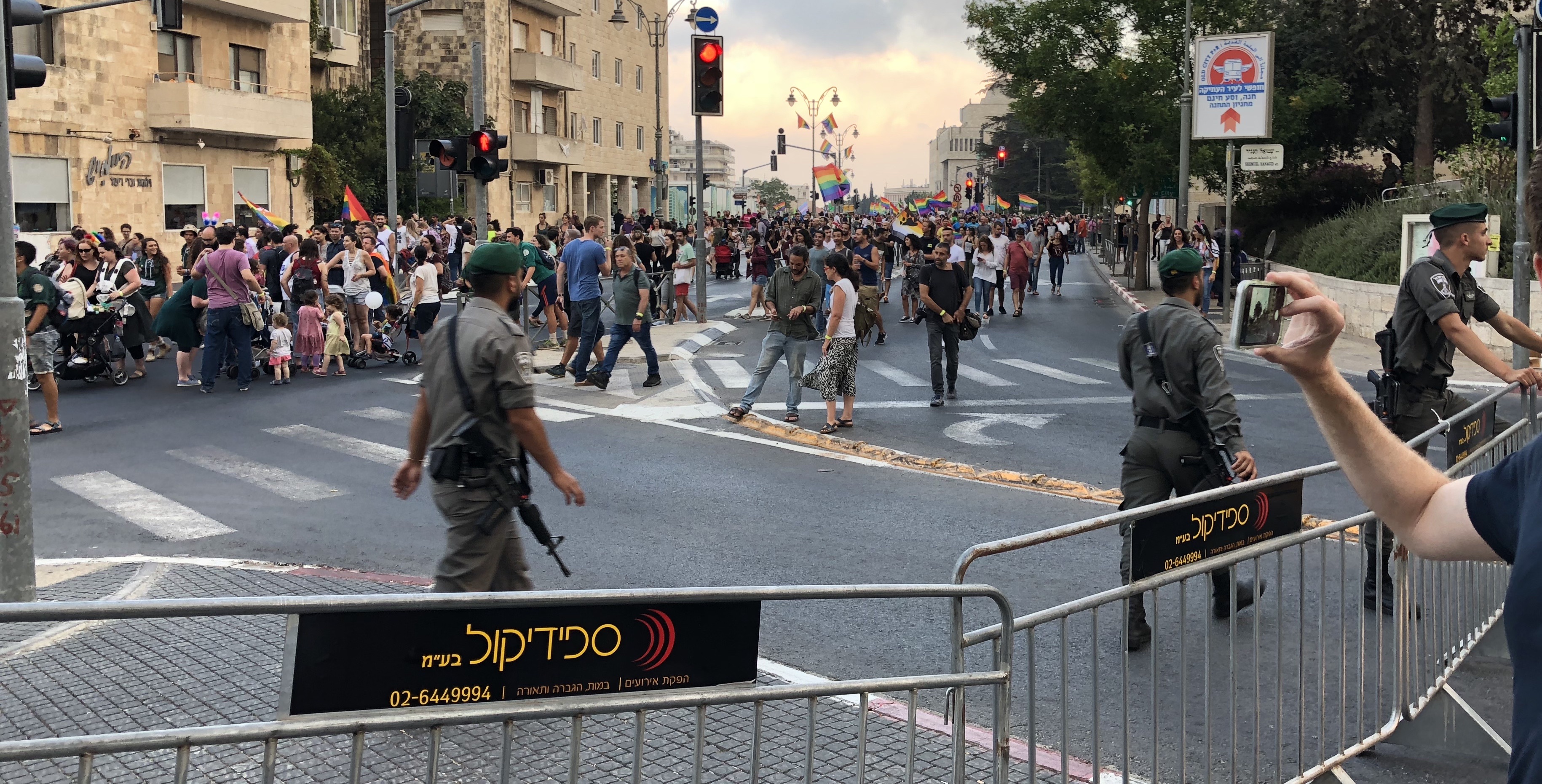
We watched from the lobby of the hotel as thousands of marchers waving pride flags boldly swept through the city – a torrent of human dignity of all ages and abilities and complexions – All with the multi-colored message that love is more powerful than……anything. Hosanna!

Four of our contingent of clergy, felt the pride of this parade in our own bones. This was our parade. We were so encouraged and hopeful by the throng of supporters. Hosanna! And yet, we could not forget the protestors on the road as we entered. Or their angry signs. Crucify them!
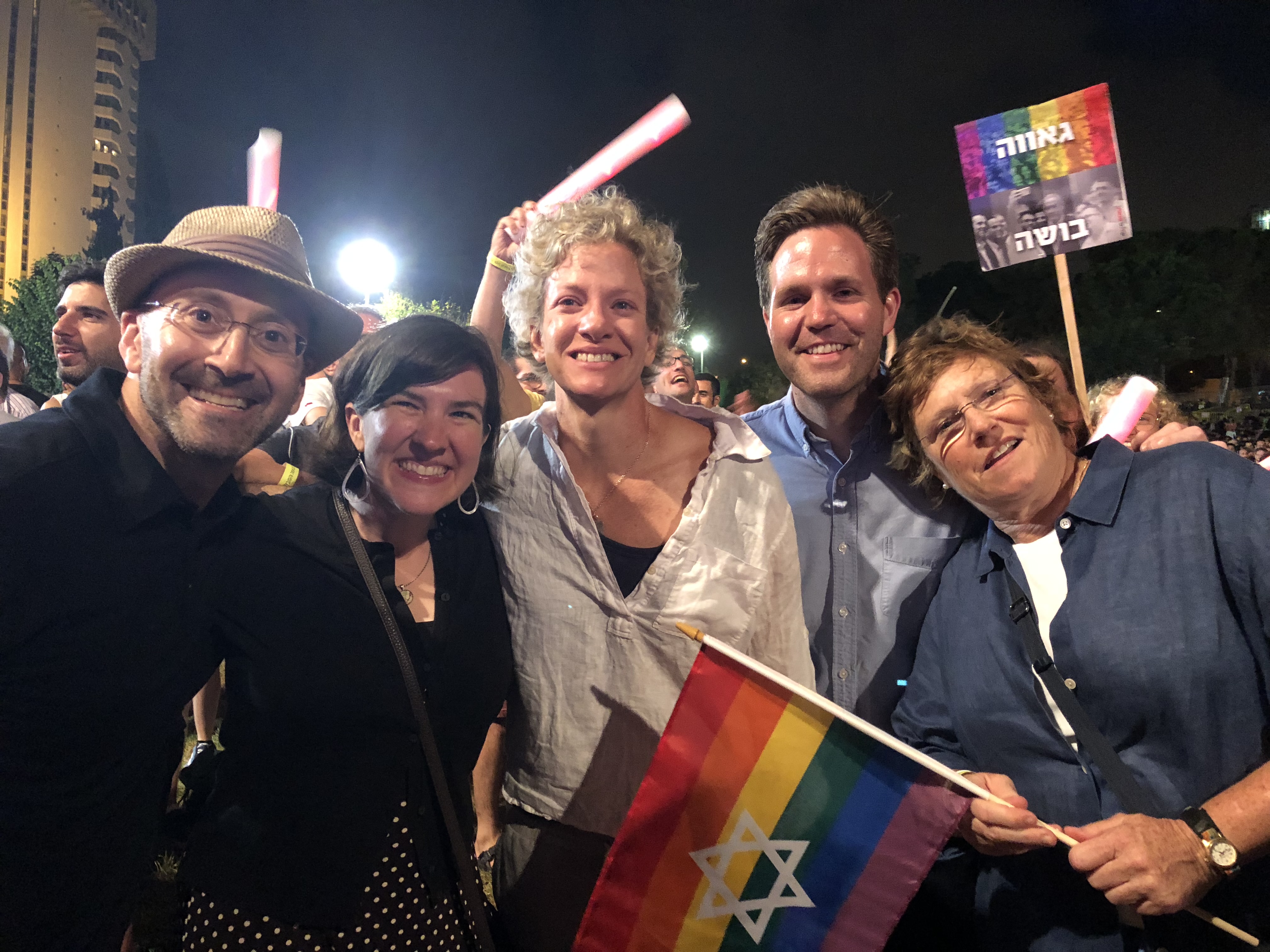
After we had checked in to the hotel, the four of us wrenched our way into the crowd and marched side by side with all manner of pride-full people- Jews and Palestinians alike, some wearing t-shirts that said, “God created me this way” and “Love your neighbor as yourself.” An international glob of humanity connected only and forever by our insistence on love. Not separated by land rights or national affiliation or even religious tradition. We were connected, Christians and Jews and Muslims and folks of no religious affiliation at all, connected by our faith in love alone. There, in the heart of Jerusalem.

In the very place where love was sentenced to death. Where 2000 years ago such a gathering of people celebrating love in this very place, turned to the most renowned execution of all time. In the shake of a lamb-of-God’s tail, as it were.
But standing there in that place at that time was a visceral reminder that this story that we imagine every Palm Sunday, as though it were ancient history, is alive and well 2000 years hence.
Every one of us can see and hear and feel ourselves in at least a part of the story that we heard this morning. We recognize, we re-cognize, literally we re-know this story in our own lives. The ways in which we betray each other and are betrayed. The ways in which we deny each other and are denied. The ways in which we turn on each other, and sometimes sell each other down the river or up onto the cross, to protect our own ….well, whatever it is that we fear losing more than we fear losing our own personal power, as the Jewish elite did with Jesus.
But also in the ways in which we tend each other and are tended….like the woman who anointed Jesus. The ways in which we bear each other’s crosses when the weight is simply too devastatingly heavy to bear by ourselves….like Simon of Cyrene. And the way we can count on a few companions to go the distance with us….like the women who followed Jesus from Galilee and waited for him at the foot of the cross. I dare say each of us has walked in all of these shoes at one time or another. And so it is not hard for us to hear this story as familiar…in our very bones.
And that is the very point of Palm Sunday.
It is the moment at the start of Holy Week when we are invited to situate ourselves in this chapter of our Jesus story. To look around us and notice where we stand. And to plant our feet on the path of…..life. Each year, we hear the climax of this story on Good Friday from a different Gospel perspective.
Last year, we heard Mark’s version which calls out our human vulnerability. Most of us can relate to Mark’s recounting of Jesus’ last words on the cross: “My God, My God! Why have you forsaken me!?” Mark invites us to relate to Jesus in the deepest suffering of our own being. This is Jesus giving us permission to doubt God in the depth of our suffering. Permission to feel abandoned. Permission to question where God is in our despair. Because Jesus did.
But not in Luke. This year in Luke, Jesus’ last words on the cross are not pastoral, they are much more…..political. And I mean political as in having to do with the realm of public affairs. That is, how we are in relationship to and with each other. As we have been hearing all year, Luke’s Gospel is the divine manual for love in action; how we are meant to treat each other when the rubber meets the road.
In Jesus’ last words from the cross, Luke beckons us not to relate to Jesus’ anguish, but to wake up and realize what is really happening. To get to the truth of the travesty. To realize that the institutions of the day, the state and the religious elite and all of their explicit and complicit supporters have crucified an innocent man.
That is Luke’s primary message in telling of the passion narrative. In Luke, Jesus’ message from the cross is : Father forgive them for they know not what they do. They do not know that they are taking an innocent life. This is the both the ultimate crime against humanity and the cost of a life lived according to love alone. That innocent children of God are put to death. That the image of God that is etched on their hearts is worth less than…the image of God etched on others.
In Matthew and Mark, after Jesus dies, the centurion says: this man truly was the Son of God.
But in Luke, after Jesus dies, the centurion says: this man truly was innocent. Even Pilate says that Jesus is innocent. Three times. He says to the crowd, “Why, what evil has he done? I have found in him no ground for the sentence of death.” If nothing else, everyone agrees that Jesus is an innocent man. And yet the crowd demands his demise, his destruction, anyway.
It’s easy to pass right over this seemingly obvious detail. That Jesus was innocent. But I think it is at the heart of what Luke wants us to know about the caliber of love that Jesus has come to share. Love is always innocent.
Luke calls us to make the connection between the execution of Jesus and the execution of equally innocent life in our own context. And Holy Week is the perfect time to ask Whose innocent blood stains our own hands in this world in which we live?
Father forgive them for they have no idea what they are doing. The words of Jesus as he hung on the cross. That was then. But this is now.
And now we do know what we are doing. We do know that we are complicit in the destruction of innocent lives. And we do know that our leaders are committing unspeakable crimes to innocent neighbors in the name of profit and power. We do know that the least among us are the most at risk. We do know that suffering is unfolding far and wide with our tacit permission. We do know what we are doing. We do know what is being done in our name.
Palm Sunday is our wake up call.
So let us plant our feet firmly in Jerusalem this morning. And remember who and whose we are.
And then let us set our clocks ahead to love.
Welcome to Holy Week.
Amen.
 The Grim Review